
Why Invest in Bangladesh’s Capital Market? Seven Ways Investing Can Add Value to Your Financial Life
BEGINNER’S GUIDE — EPISODE 01
Seven Ways Investing Can Add Value to Your Financial Life
LEARN BEFORE YOU INVEST
Imagine two people beginning their careers at the same time. Both work hard, earn a reasonable salary, and try to save something at the end of each month.
One keeps all those savings aside, while the other gradually begins learning how businesses operate, how the economy changes, and how a small portion of savings can be invested in productive companies.
Twenty years later, their financial journeys may look quite different.
The second person may have experienced market losses, made mistakes, and gone through periods when investing seemed frustrating. Yet, along the way, something important may have happened.
Beyond building financial assets, that person developed an understanding of businesses, economic cycles, corporate decisions, and the relationship between risk and return.
This is one of the most overlooked reasons to participate in the capital market.
In Bangladesh, many people approach the stock market with one question: Which share should I buy to make a quick profit? But perhaps the more valuable question is: How can investing become a meaningful part of my financial life?
The capital market is not a guaranteed source of wealth. Prices fluctuate, companies sometimes disappoint, and even experienced investors can lose money.
However, with patience, knowledge, and discipline, it can offer benefits that extend far beyond short-term price movements.
Let’s explore seven reasons why participating in Bangladesh’s capital market may be worth considering.
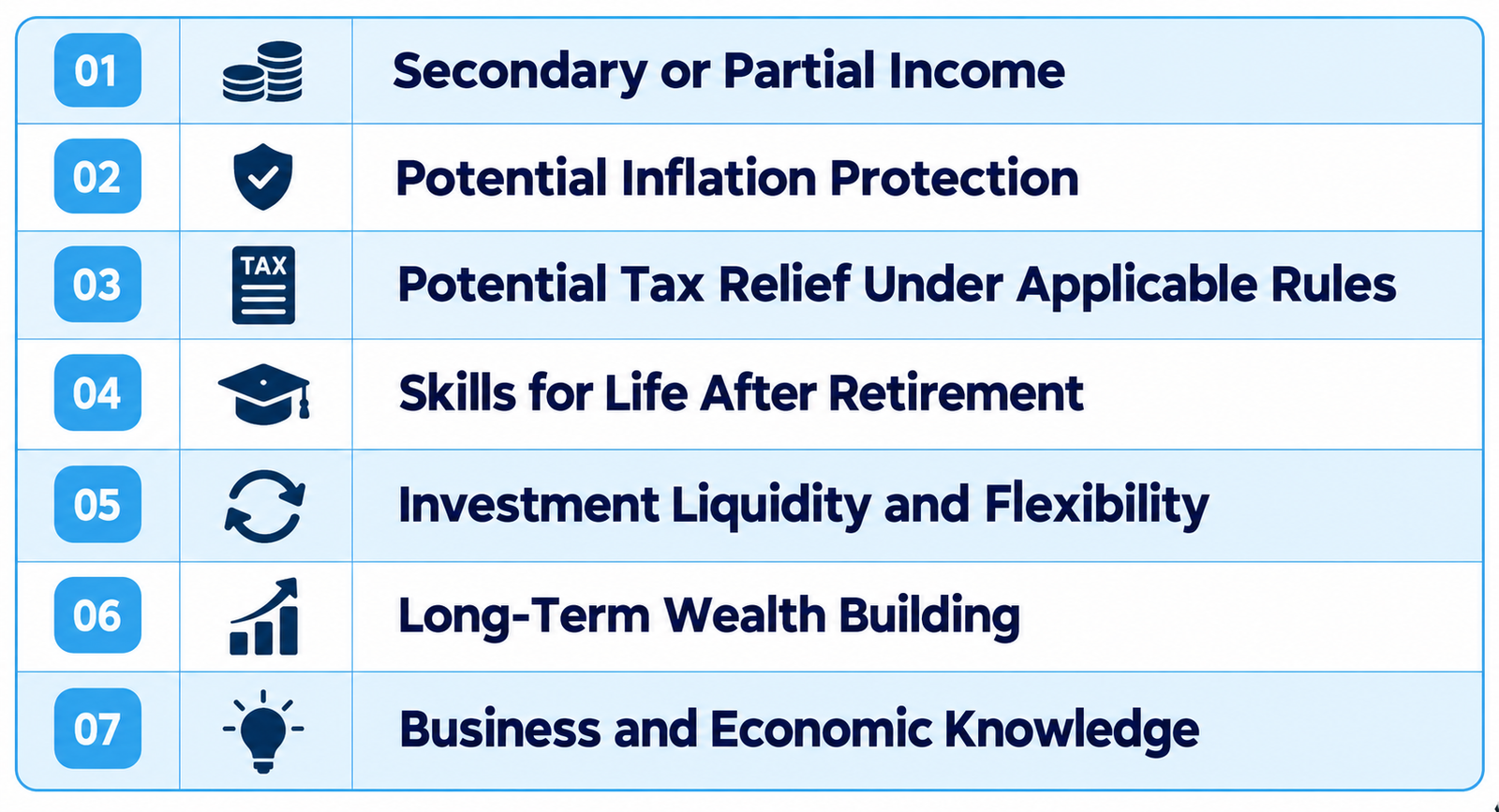
Secondary or Partial Income
Your salary may be your primary income, but does it have to be your only financial opportunity?
For most working professionals, income depends heavily on one source: their job or business. Monthly expenses continue regardless of whether that income increases, remains unchanged, or unexpectedly stops.
This is where investing can offer another possibility.
Imagine a professional who earns Tk 60,000 per month. After meeting regular expenses, they gradually build an investment portfolio from their savings. Over time, that portfolio may generate returns through several channels.
- Cash dividends: Eligible shareholders receive a portion of profits distributed by companies.
- Capital gains: Investors may earn a profit by selling shares at a price higher than their purchase cost.
- Trading spread opportunities: Investors or traders may benefit from price differences between buying and selling transactions,
- Provided those differences exceed costs.
- Reinvestment and compounding: Returns retained and reinvested may contribute to long-term portfolio growth.
But these sources are not equivalent to a regular salary. Dividends can be reduced or suspended, capital gains are uncertain, and trading may result in losses.
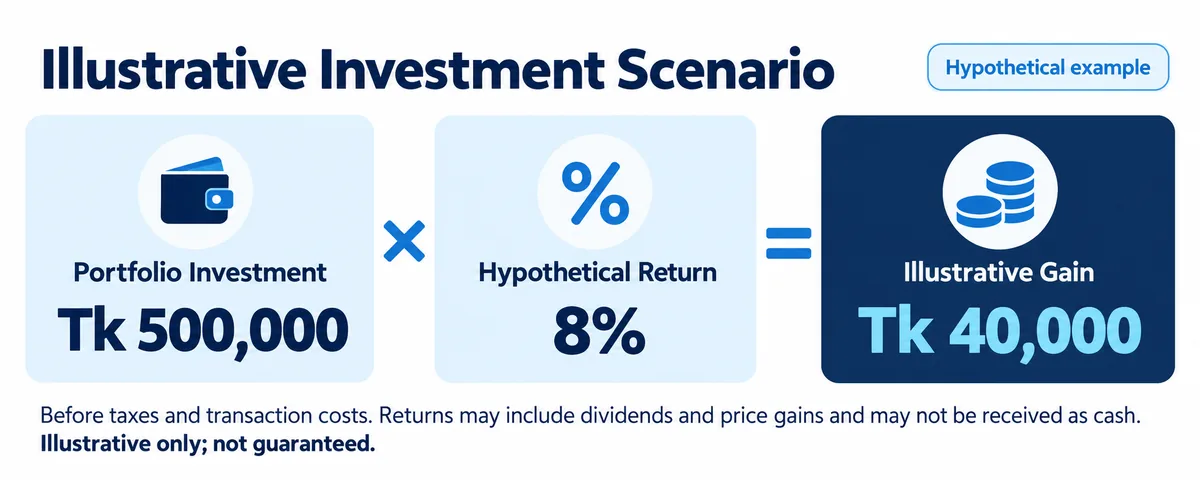
Consider a portfolio of Tk 500,000. If it generates a hypothetical 8% total annual return, the gain would be Tk 40,000 before taxes and transaction costs. That return could come from dividends, price appreciation, or a combination of both. It would not necessarily be received as regular cash income.
The important lesson is not that investing guarantees additional income. Rather, it creates the possibility of building a financial asset that may contribute to your income over time. For someone who depends entirely on employment, even a modest additional source of financial returns can become meaningful.
Potential Inflation Protection
Saving money protects the amount you have. Investing may help protect what that money can buy.
Think about the cost of everyday life in Bangladesh ten years ago. Groceries, transport, healthcare, education, and housing have all become more expensive over time. Even when your savings balance remains unchanged, its purchasing power can gradually decline.
This is the quiet effect of inflation.
Suppose you have Tk 100,000 today. If inflation averages 7% annually, the same amount of money would have purchasing power equivalent to approximately Tk 71,300 in today’s terms after five years.
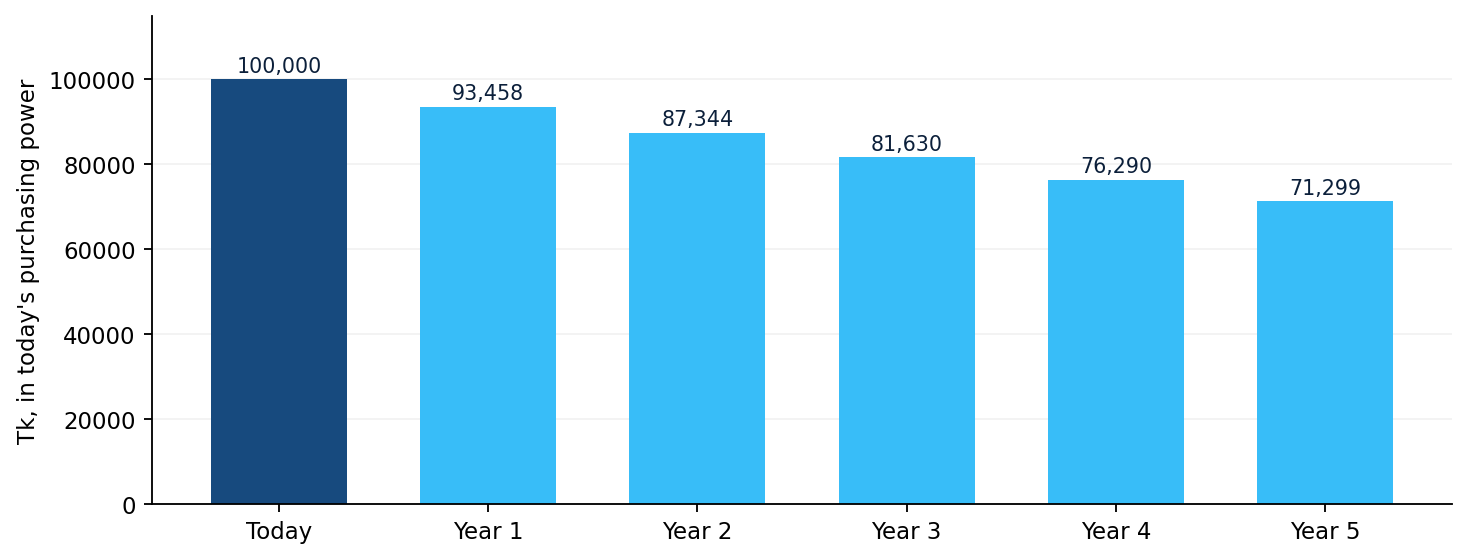
This does not mean everyone should immediately move their savings into stocks. Rather, it means investors should understand the difference between nominal returns and real returns.
If an investment earns 10% while inflation is 7%, the real return is approximately 2.8%, before taxes and other costs.
Over long periods, ownership in profitable businesses can potentially help investors preserve or increase purchasing power. Companies with strong competitive positions may be able to grow earnings as prices and economic activity change.
However, equity returns can also fall below inflation, sometimes for extended periods. The objective is not simply to grow your money, but to grow its purchasing power.
Potential Tax Relief Under Applicable Rules
What if a thoughtful investment decision could also offer certain tax advantages?
When people think about investing, they usually focus on two things: how much they can earn and how much they might lose. But there is another factor that can influence the actual benefit of an investment—taxation.
Imagine two individuals earning similar annual incomes. Both save money regularly, but one takes time to understand how different savings and investment instruments are treated under Bangladesh’s income tax rules.
That knowledge may help the second person make more tax-efficient financial decisions, provided they meet the relevant eligibility requirements.
Bangladesh’s tax framework has included provisions relating to eligible investments, capital gains, dividends, and certain securities. However, these provisions differ by investment type, taxpayer category, income level, and assessment year.
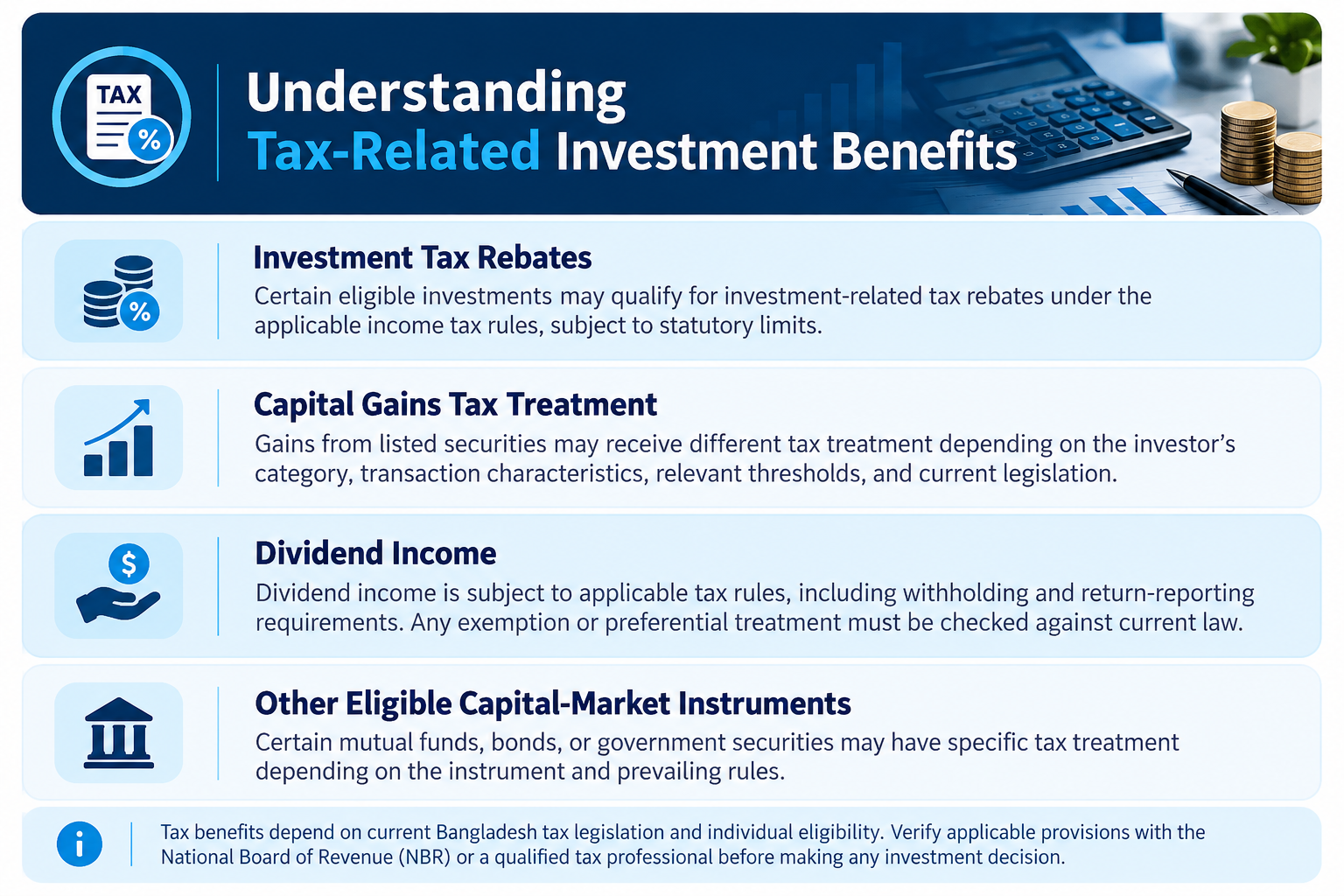
Investment tax rebates: Certain eligible investments may qualify for investment-related tax rebates under the applicable income tax rules, subject to statutory limits.
Capital gains tax treatment: Gains from listed securities may receive different tax treatment depending on the investor’s category, transaction characteristics, relevant thresholds, and current legislation.
Dividend income: Dividend income is subject to applicable tax rules, including withholding and return-reporting requirements. Any exemption or preferential treatment must be checked against current law.
Other eligible capital-market instruments: Certain mutual funds, bonds, or government securities may have specific tax treatment depending on the instrument and prevailing rules.
For example, someone investing in an eligible instrument may be able to claim an investment-related rebate if the instrument and taxpayer satisfy the relevant conditions.
However, purchasing ordinary listed shares does not automatically mean that every amount invested qualifies for a rebate.
Tax regulations may change through Finance Acts, statutory amendments, notifications, or other official measures. Therefore, the benefit available in one assessment year may not remain identical in another.
Investors should verify current provisions through the National Board of Revenue (nbr.gov.bd) or a qualified tax professional before making a tax-related investment decision.
A poorly selected investment can lose considerably more money than any tax advantage it might provide. Tax efficiency can improve an investment’s overall outcome, but business quality, valuation, liquidity, and risk must come first.
Skills for Life After Retirement
Your professional career may eventually end, but your ability to understand businesses and investments does not have to.
Retirement is often viewed as the end of an earning career. But for many people, it can also mark the beginning of a different relationship with money.
Consider someone who has worked for 30 years in banking, teaching, engineering, government service, or corporate management. Throughout that career, they may have accumulated savings, experience, judgment, and professional knowledge.
Yet, after retirement, one important question remains: How can I manage my savings wisely while remaining financially active?
Learning about the capital market during working life may help answer that question. A person who spends years studying financial statements, company performance, economic conditions, and investment risk can gradually develop a valuable skill set.

- Evaluate the quality and financial condition of businesses.
- Understand how interest rates, inflation, and economic policies affect investments.
- Assess portfolio risk and diversification.
- Make more informed decisions about retirement savings.
- Maintain intellectual engagement with the business and economic world.
Retirement investing, however, requires particular caution. Someone relying on accumulated savings for essential expenses generally has less capacity to recover from major losses.
That is why learning should begin well before retirement, and equity investing should form only an appropriate part of a broader retirement plan.
The capital market should not be treated as a guaranteed retirement profession or dependable monthly income source. Instead, investment knowledge can become a lifelong financial skill—one that remains useful long after a formal career ends.
Investment Liquidity and Flexibility
An investment becomes more useful when you understand how easily it can be converted into cash.
Imagine owning land, a small business, or a long-term physical asset. These investments may have value, but selling them can require substantial time, negotiation, documentation, and transaction expenses.
Listed securities offer a different form of ownership. During normal market operations, investors can place sell orders through their brokerage accounts and potentially convert securities into cash, subject to market liquidity, settlement rules, and trading restrictions.
This relative liquidity can be an advantage. However, not every listed share is equally liquid.
A stock with low trading volume may be difficult to sell at a reasonable price. In a falling market, an investor may have to accept a significant loss to exit quickly. Trading suspensions and settlement requirements can also delay access to funds.
Therefore, liquidity should be considered at both the market and individual-security level.
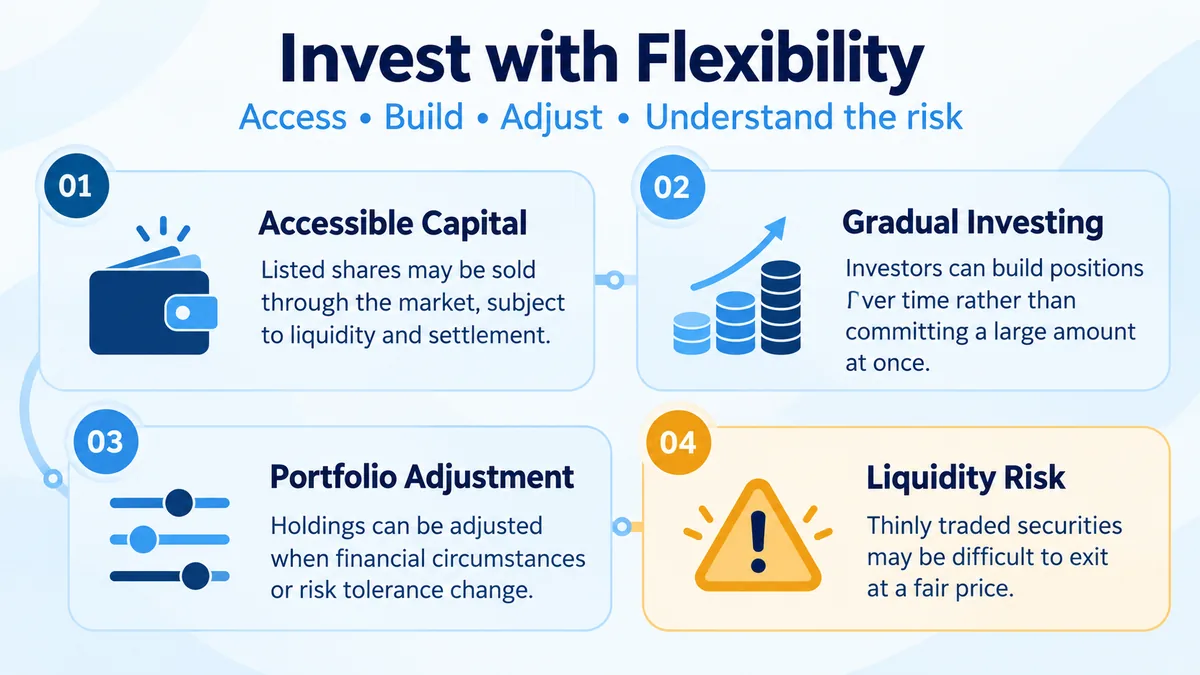
The key is to maintain adequate emergency savings outside the stock market so that unexpected expenses do not force the sale of investments during unfavorable conditions.
Long-Term Wealth Building
Wealth is not always created through one extraordinary investment. Sometimes, it develops through many ordinary decisions made consistently.
Consider a young professional who begins setting aside Tk 3,000 every month. At first, the amount may seem too small to make a meaningful difference. But consistency changes the picture.
Over 20 years, monthly contributions of Tk 3,000 would total Tk 720,000.
If those contributions earned a hypothetical 8% annualized return, compounded monthly, the portfolio could grow to approximately Tk 1.77 million before taxes and fees.
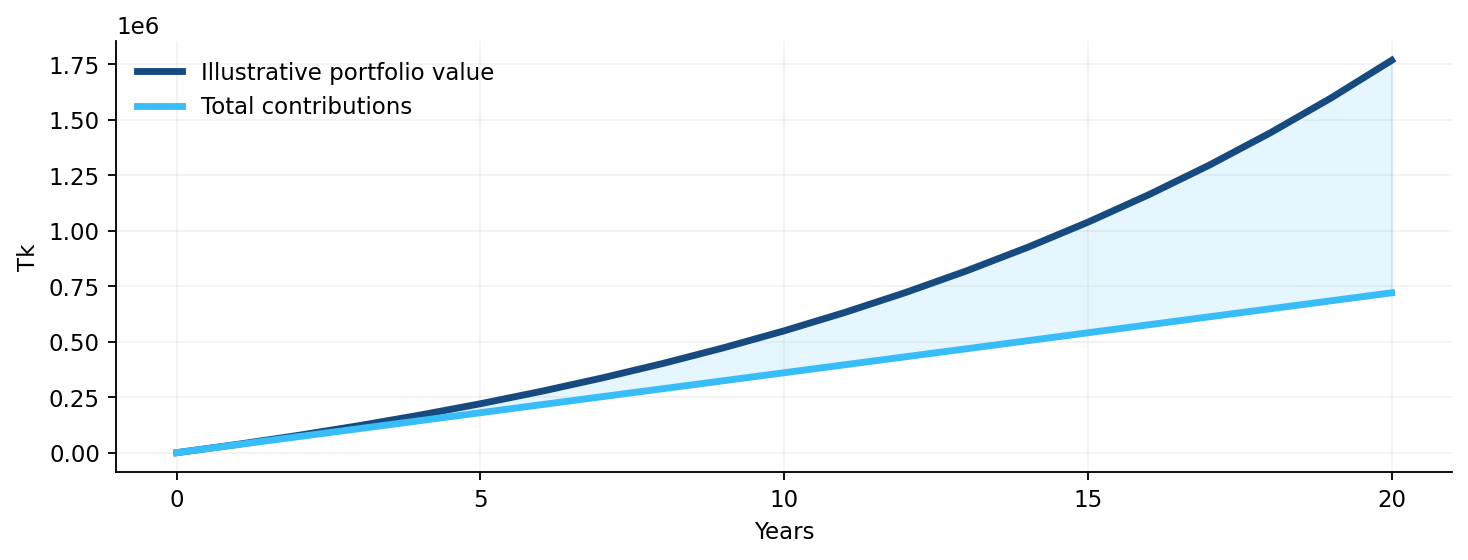
Real stock market returns are uneven. Some years may deliver strong gains, while others may produce substantial losses. An investor could also end up with less than the amount contributed.
The example simply illustrates how regular saving, reinvestment, and time can interact under a positive-return assumption.
Long-term wealth building requires more than buying and holding any stock. It involves choosing investments carefully, avoiding excessive concentration, managing costs, and periodically reviewing the portfolio.
Perhaps most importantly, it requires resisting the temptation to treat every market movement as an opportunity for quick profit.
“Price is what you pay. Value is what you get.” — Warren Buffett
Business and Economic Knowledge
The more you understand what moves businesses, the better you understand the world around you.
Have you ever wondered why a change in the US Federal Reserve’s interest rate can influence investor sentiment in Bangladesh?
Or why rising crude oil prices may affect the profitability of certain listed companies? Why can a weaker taka create difficulties for some businesses while potentially benefiting others?
These questions become more interesting when you begin studying the capital market. A thoughtful investor gradually learns to connect company performance with broader economic developments.
For example, someone researching a pharmaceutical company may begin examining imported raw-material costs, foreign exchange movements, production capacity, regulatory approvals, and export potential.
Someone studying a bank may start understanding deposit costs, loan growth, asset quality, capital adequacy, and interest-rate movements.
Suddenly, financial news is no longer just a collection of headlines. It becomes a network of relationships.
“Know what you own, and know why you own it.” — Peter Lynch
This principle goes beyond stock selection. It encourages curiosity, analytical thinking, patience, and independent judgment.
Even when an investment does not perform as expected, the process of studying businesses can develop knowledge that remains valuable. Investing is not only an opportunity to build financial capital. It can also help build intellectual capital.
Investing Is an Opportunity, Not an Obligation
The seven benefits discussed above are meaningful, but they should not overshadow the risks.
Bangladesh’s capital market has experienced periods of significant volatility, weak liquidity, governance concerns, and prolonged corrections. Investing without sufficient understanding can lead to substantial financial losses.
Before participating, an investor should consider their financial stability, emergency savings, outstanding debt, investment horizon, and ability to tolerate losses.
Learning should come before committing significant capital. A practical starting point is to understand how the market works, study listed companies, develop a basic investment process, and gradually build experience without relying on borrowed money. There is no need to rush.
Invest in Knowledge Before Investing in Shares
The real value of participating in the capital market is not limited to the possibility of earning a dividend or selling a share at a higher price.
It can offer a secondary income opportunity, a potential defense against inflation, certain tax advantages where legally available, useful financial skills for retirement, investment flexibility, a disciplined path toward long-term wealth creation, and a deeper understanding of the economy.
But none of these benefits arrive automatically. They depend on financial circumstances, investment choices, market conditions, applicable tax rules, and—above all—the willingness to learn.
For Bangladesh’s retail investors, perhaps the most important change is to stop viewing the stock market merely as a place where prices rise and fall, and begin understanding it as a place where businesses, capital, risk, and economic opportunities meet.
The journey should not begin with finding the next winning stock. It should begin with understanding why you are investing in the first place.
Continue Your Learning Journey
This is the first article in the Learn Before You Invest educational series by DSE Market Pulse. Next article: How to Evaluate a Company Before Investing in Its Shares. Visit https://dsemarketpulse.com/



Leave a comment
Please login to leave a comment or reply.