

DSEX Weekly Update: Correction Deepens as the Market Awaits a Stronger Support Base
The DSEX closed the week around 5,515 points, extending its correction as the index failed to hold the previous support zone.
Last week's analysis highlighted the importance of the 5,620–5,640 support area. The index has now moved below that level, bringing the next Fibonacci support into focus.
While falling domestic yields remain a positive factor, rising crude oil prices and renewed geopolitical uncertainty have created fresh pressure on the market.
So, what are the key factors shaping the DSEX this week?
Let's try to find the answer by analysing the key factors.
Macroeconomic Factors
The gradual decline in domestic government-security yields remains a positive development for the capital market.
The 5-year government bond yield is now below 9%, around 8.68%, which could gradually improve the relative attractiveness of equities.
However, the impact may take time to materialise. Investors may become more interested in the market as valuations improve and greater certainty returns.
For now, lower yields remain a long-term supportive factor, but not an immediate trigger for broad-based buying.
External Factors
The global oil market has become the biggest concern for the DSEX in the coming weeks.
Renewed tensions around the Strait of Hormuz and Bab el-Mandeb have increased uncertainty over energy transportation. Brent crude has moved above $100 per barrel, recently trading around $104–105.
For Bangladesh, a prolonged rise in crude prices could increase import costs, inflationary pressure, and energy-related expenses.
Therefore, the direction of crude oil could become one of the most important external variables for the DSEX movement in upcoming days
Internal Factors
The existing power-supply disruption remains a concern, although the government continues to work toward managing the situation.
The disruption could potentially continue until November–December, when winter arrives, and household electricity demand may ease.
However, if the Middle East crisis persists and crude prices remain elevated, another increase in domestic fuel and gas prices could become a possibility.
The government may not be able to sustain energy subsidies indefinitely if international prices remain high.
At the same time, prolonged power and gas shortages could lead to production losses across RMG and other industrial sectors, putting additional pressure on corporate earnings and overall economic activity.
Therefore, the duration of the energy-supply disruption and the direction of global crude prices will remain important domestic factors for the market.
TA Chart Concern
The technical picture has weakened further compared with last week's analysis.
The DSEX has moved below the previous 5,620–5,640 support zone, which was the key level identified in the earlier update.
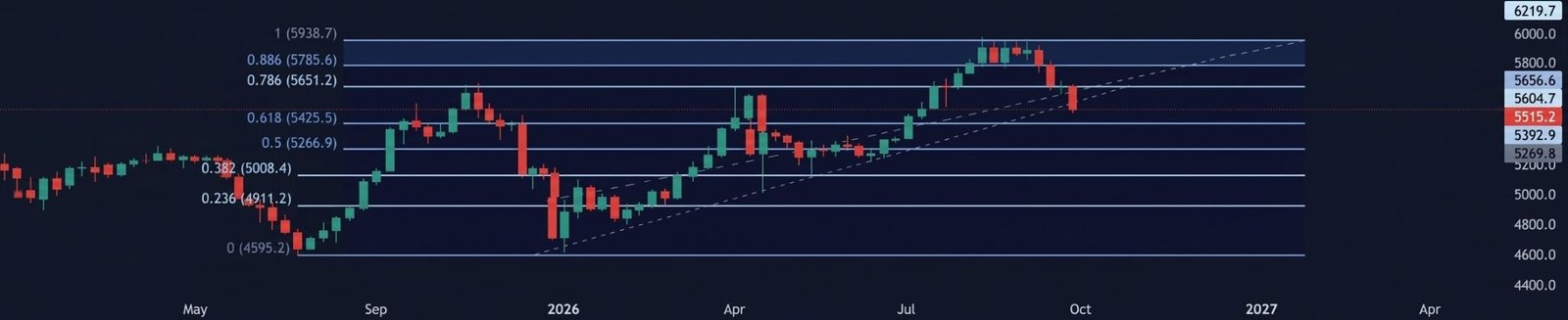
From here, the index may attempt a recovery toward that area of 5620-5640, which now becomes the nearest resistance zone.
At the downside, the 5,395–5,420 area is the next major support zone to watch.
The key question is whether the index can find support before reaching that level and build a new base.
A successful recovery from the next Fibonacci support could keep the broader recovery possibility alive.
However, a decisive break below the 0.618 golden-ratio zone would increase the probability of a deeper correction, with the 5,270–5,305 area coming into focus.
For now, the market needs to prove that selling pressure is easing and buyers are willing to return.
Investor Focus This Week
The market currently presents a mixed picture. Falling domestic yields provide a constructive long-term signal, while rising crude oil prices and energy-related disruptions create significant near-term risks.
From an investor's perspective, the focus may gradually shift toward money flow and sector rotation rather than expecting an immediate broad-based recovery.
Last week's buying interest was mainly concentrated in the Textile and Insurance sectors, while Pharmaceuticals and Food could attract attention as relatively non-cyclical sectors.
The Bank sector also requires stronger turnover and fresh participation to support a meaningful recovery.
During this low-turnover phase, selected individual stocks, lower-priced shares and a few Mutual Fund scripts may continue to offer opportunities, although investors should remain selective.
For now, the key question is whether fresh money can enter new sectors and support a sustainable recovery, or whether external risks will continue to limit market participation.
Weekly Zist
The DSEX recovery has lost momentum, but the long-term macro picture is not entirely negative.
Lower domestic yields can gradually support equity valuations, while the current oil-price shock remains the biggest near-term concern.
Technically, the index has moved below its previous support structure, bringing the next Fibonacci support into focus.
For now, the market may remain under pressure until either external risks ease or the DSEX finds strong technical support with renewed buying participation.
The next support test could determine whether this is another correction within the broader recovery—or the beginning of a deeper adjustment.







Leave a comment
Please login to leave a comment or reply.