

The DSEX Return in November: Can the Market Find Its Footing After Declaration Season?
November arrives with a different question for Bangladesh’s stock market. After weeks of earnings reports and dividend declarations, can investors find enough confidence to buy again—or will the disappointment carry into another month?
October’s recent record gives that question some weight. In the supplied dataset, every October from 2015 to 2025 ended lower than the previous month. November, however, has not always followed the same path.
Read More: The DSEX Return in October: What Investors Should Know as Declaration Season Begins
What the November Numbers Reveal
Across the thirteen completed Novembers from 2013 to 2025, the DSEX recorded six gains and seven declines. Its average November return was approximately +0.06%, while the median was −0.05%—both close to flat.
That quiet average hides a much livelier history.
More recently, the picture changed. Every November from 2021 to 2025 finished lower, producing an average decline of approximately 1.84% across those five observations.
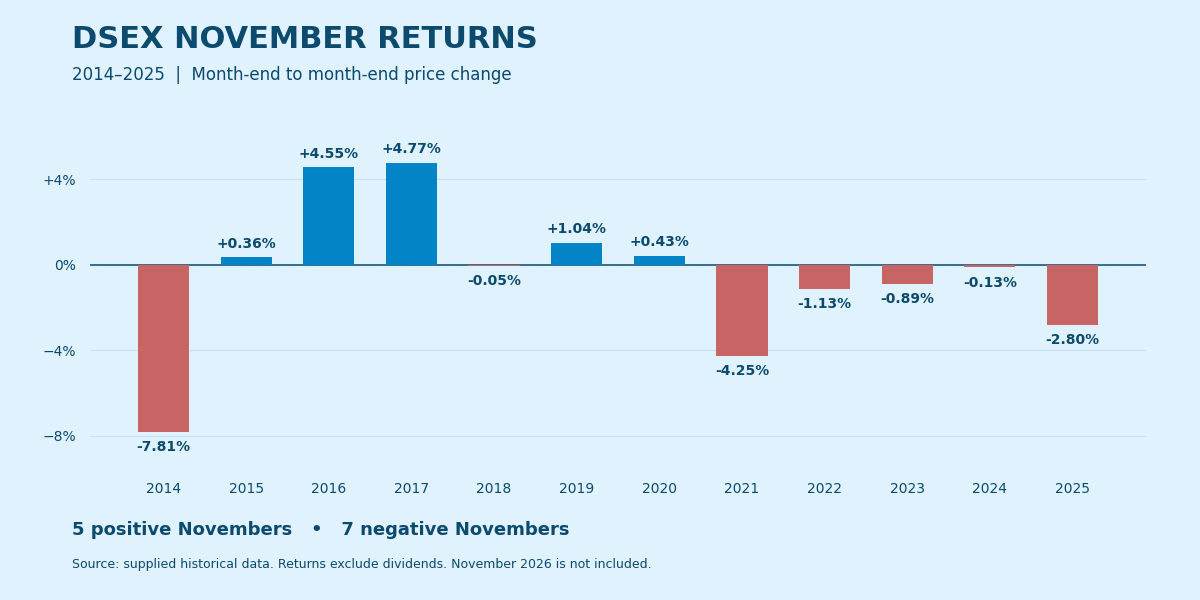
November 2013 gained 6.63%, the strongest observation in the sample. Just a year later, November 2014 lost 7.81%, the weakest. The market then delivered gains of 4.55% in 2016 and 4.77% in 2017.
These figures describe separate November price returns, not annual investment returns. November 2026 has not occurred and is excluded.
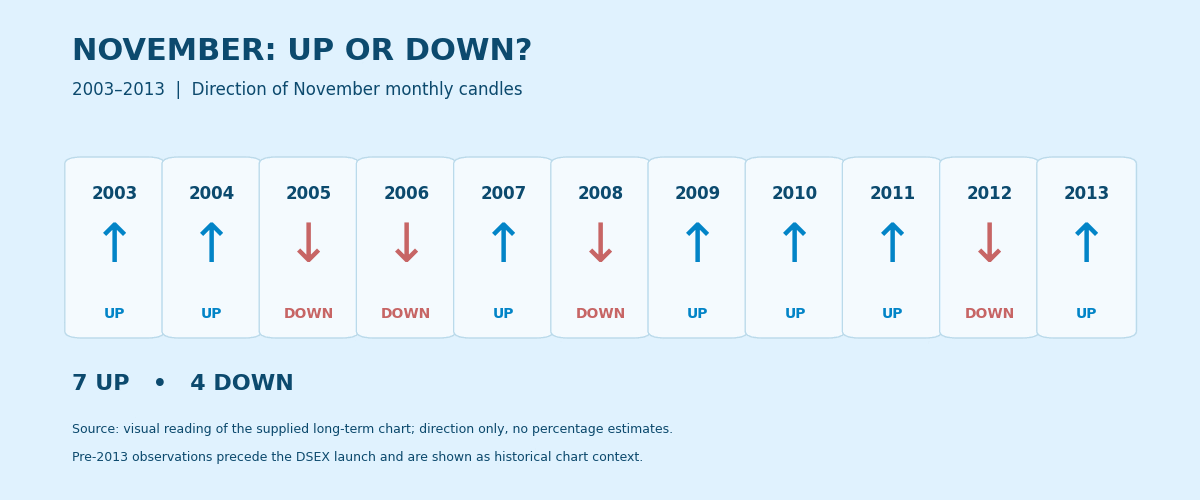
Why November Keeps Investors Reading the Numbers
October is often when investors compare their dividend expectations with corporate announcements. November gives them more evidence about whether those expectations were realistic.
Under Regulation 17(1) of the DSE Listing Regulations, 2015, first-quarter financial statements have a 45-day reporting window. For companies with a June financial year-end, that carries the September-quarter reporting cycle into mid-November.
A company may announce an appealing annual dividend, yet its latest quarter can tell a less comfortable story. Sales may have slowed, finance costs may have risen, or reported profit may not be turning into operating cash flow. Equally, improving quarterly results can give investors a reason to revisit a share they had previously overlooked.
This creates a plausible channel for both buying and selling. It does not establish that reporting season caused November’s historical returns.
When Buyers Found a Reason to Return
The stronger Novembers show why a weak October does not automatically settle the next month’s direction.
In November 2016, contemporary reporting identified renewed interest in banking and financial shares as a source of market optimism. That buying provided support even as some investors took profits. The DSEX finished the month 4.55% higher.
In November 2017, investors again put fresh money into major shares. Reports described buying in financial institutions, banks and large companies including Square Pharmaceuticals and Grameenphone as the index reached new highs. The month ended with a 4.77% gain.
Those reports help explain the buying seen during these months; they do not measure each factor’s contribution to the full monthly return. Still, the message is useful: when investors find convincing reasons to commit money, November can recover from October’s weakness.
When Confidence Was Harder to Rebuild
The recent losing streak unfolded under several different pressures.
In 2021, the DSEX fell 4.25%. Late-November reports described concern over bank liquidity, disagreement between financial regulators, and continued foreign selling. Omicron added another worry near month-end. These pressures help explain why buyers were hesitant even after prices had fallen.
In 2022, the index lost 1.13%. High inflation, rising business costs and a stronger dollar were weighing on corporate earnings. Floor prices also left many shares difficult to trade, while turnover weakened. Bargain hunting lifted the final two sessions, but the recovery did not erase the month’s loss.
In 2023, the decline was 0.89%. Political tension before the national election compounded macroeconomic concerns and a market already constrained by floor prices. Contemporary reports described investors reducing exposure as confidence weakened.
In 2025, November ended 2.80% lower. Political uncertainty and concern over newly introduced margin rules accompanied a sharp sell-off during the first half of the month. By 13 November, the DSEX had fallen to about 4,702; the supplied month-end value of 4,978.77 shows that part of that fall was subsequently recovered. The monthly number therefore hides both a deeper decline and a rebound. [7]
These were documented pressures during the periods concerned, rather than proof of a single recurring November cause. The near-flat −0.13% return in 2024 also cautions against describing every recent November as a major sell-off.
What the Pattern Means for Investors
Five negative Novembers deserve attention. They do not make the next one’s outcome certain.
The longer record is almost evenly divided between gains and losses. Even after the eleven negative Octobers from 2015 to 2025, November recovered in five years and declined in six. October weakness alone has therefore offered little certainty about what comes next.
The more useful question is whether a company’s latest results support the price investors are being asked to pay. A dividend announcement becomes more meaningful when earnings, operating cash flow and the business outlook support it. A lower share price deserves the same scrutiny: it may offer value, or simply reflect weaker prospects.
November is a month when the market starts living with the numbers it has received. Some years, those numbers and the wider environment help confidence return. In others, investors need more time—and better evidence.
The calendar tells us when to pay attention. The quality of the business, its valuation and the strength of buying participation tell us much more about the investment case.
Previous Related Articles:
- DSE Listing Regulations, 2015, Regulation 17.
- New Age, 18 November 2016: Stocks rally for 3rd day as bank shares keep gaining
- New Age, 20 November 2017: DSEX extends record-making rally
- New Age, 30 November 2021: Stocks plunge amid worries
- The Business Standard, 30 November 2022: DSEX bounces back at the end of a volatile month
- The Financial Express, 21 November 2023: Stocks keep bleeding as investors are jittery ahead of polls
- The Business Standard, November 2025: DSEX loses 419 points, market cap drops Tk25,572cr since 2 Nov.

Leave a comment
Please login to leave a comment or reply.